History of the Noble GreyhoundThe connection between mankind and his closest animal friend, the dog, goes far back beyond the mists of time. Bone fragments found in archaeological digs of Cro-Magnon sites show even primitive man shared his home with dogs. Greyhounds are mentioned throughout history - possibly dating back 4,000 years ago. Early recorded cases of man's affection for his canine friends are found in the tombs of the Egyptian pharaohs. Among the images of the Gods, are pictures of the pharaohs in chariots which are closely followed by dogs very similar to modern day Greyhounds and Salukis.Greyhounds are linked closely with Egypt's royalty such as Tutankhamen, Amenhotep II, Thutmose III, Queen Hatshepsut, and Cleopatra VII who were known to have owned Greyhounds. History is littered with Greyhound lore. For example, the Greyhound is the only breed of dog to be mentioned by name in the Bible (Proverbs 30:29-31): There be three things which go well, yea, Which are comely in going; A lion, which is strongest among beasts and Turneth not away from any; A greyhound; A he-goat also. In ancient Arabian culture, the birth of a litter of Greyhounds, (or more probably their eastern cousin, the Saluki) was considered only slightly less important than the birth of the owner's own son. Also, the Greyhound was the only dog allowed in the tents and was even allowed to ride on top of their camels! Other famous names from history known to have had a liking for the Greyhound include Odysseus, who after being away from home for twenty years was recognized only by his faithful hound, Argus. Diana, the huntress of Roman lore, was also believed to be appreciative of the Greyhound (sighthound). It was probably the Romans who introduced the sport of coursing to Great Britain, though the sport was already popular among the Celts living in Europe at the time of the The Greyhound's royal connections continued through the Middle Ages, when they were popular with such historical figures as King Canute of England. At the time of the Norman invasion the Greyhound was a favorite among the aristocracy. Commoners were banned from owning greyhounds. The commoners started breeding greyhounds with more color variation (like brindles) as it made the dogs more difficult to spot while hunting on the lands from which they had been banned. The Greyhound's reputation was untarnished among the ruling classes. Lords and gentlemen had their tombs designed with the effigy of a faithful Greyhound, waiting forever at the feet of its beloved master. The true origin of how we come to know this lithesome animal as the "Greyhound" not known. The breed's modern name has been traced back to the middle English "Greihound" which is believed to have originated in the Icelandic "Greyhundr" by way of the old English name "Grighund." As the people of Iceland are descendants of the Norse people, it is a fair assumption that the Vikings, who occupied northern England at the time of the Norman Conquest, were aware of the Greyhound's great hunting ability. For hundreds of years after the Norman invasion, Greyhounds remained very popular among the nobility. So where did Greyhound dogs come from? Extensive research has been done and there is some confusion as to their exact origin. The Romans believed that Greyhounds came from Western Europe also known as the land of the Celts. But, the Celts believed that Greyhounds originally came from Greece, and called them "Greek hounds". The word Greyhound could also be derived from Greek hound). In the last couple years, the evidence points to the Greyhound dog did not originate in Western Europe, but most like came from the Middle East. The modern day Greyhound is very similar in appearance to an ancient breed of sight hounds that can be traced back to the Egyptians and Celts. Dogs very similar to Greyhounds - domesticated hunters with long, slender bodies - appear in temple drawings from 6000 BC in the city of Catal-Huyuk in present day Turkey. A vase dating back to 4000 BC was found in the area of modern Iran and was decorated with images of dogs looking much like Greyhounds. Since ancient artists usually depicted only images of religious or social significance to their societies, these dogs must have been fairly important to the people of those days and it is logical that those dogs may be the forerunners of the modern day Greyhound. It is very likely that the ancestors of Greyhounds and other sight hound breeds first came into being in the tents of Middle Eastern nomadic peoples. Some think that sight hounds are a cross between the domesticated dog of that era and the southern European wolf. In a movable camp setting, it was common for dogs to follow the camp, eating from trash and protecting the perimeter of the camp. But at some point, a special kind of dog was discovered -- a dog that could hunt alongside humans - on foot or on horseback. These dogs were usually kept separate from the dogs on the camp's perimeter, so that inter-breeding wouldn't ruin the special abilities of these special Greyhound type dogs. These sight hounds were given a special place inside the camp, even inside the tents, where no other animal was allowed, so that their breeding might be controlled. The unique and highly prized abilities of sight hounds help explain why they have changed very little in the last 2,000 years. 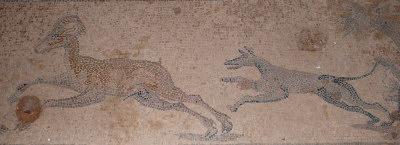
The EgyptiansIn ancient Egypt, the ancestors of modern Greyhounds were used in hunting and kept as companions. Many Egyptians considered the birth of such a hound second in importance only to the birth of a son. When their sight hound died, the entire family mourned.It was a common practice of the upper class to have their favorite sight hounds mummified and buried with their owners. The walls of Egyptian tombs were decorated with images of their hounds. An Egyptian tomb painting from 2200 BC portrays dogs that looks very much like the modern day Greyhound (for a picture of this mural, see The Complete Book of Greyhounds, , p. 8). Pharaohs known to own Greyhound-type dogs are Tutankhamen, Amenhotep II, Thutmose III, Queen Hatshepsut, and Cleopatra VII. The Egyptian god Anubis, either a jackal or a hound-type dog, is frequently displayed on murals in the tombs of the Pharaohs. Some depictions of it look much like the modern Pharaoh Hound, a close relation of the Greyhound. Ancient Greece and RomeThe Greeks probably bought some of these hounds from Egyptian merchants, some time before 1000 BC. The first breed of dog named in western literature was the ancestor of the Greyhound. In The Odyssey, written by Homer in 800 BC, the hero Odysseus is away from home for 20 years fighting the Trojans and trying to get home against the opposition of the god Poseidon. When he finally returns home, he disguises himself. The only one to recognize him was his hound Argus, who is described in terms that marks him clearly as a sight hound. Art and coins from Greece depict short-haired hounds virtually identical to modern day Greyhounds, making it fairly certain that the Greyhound breed has changed very little since 500 BC. A reason for the lack of change in 2,500 years is that, until very recently, the function of the Greyhound has remained the same: to thrill humans with its agility, speed, and intelligence as it chased the wild hare.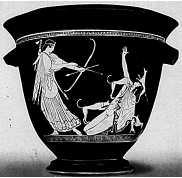
The Greek gods were often portrayed with Greyhounds. A hound often accompanied Hecate, the goddess of wealth. The god Pollux, the protector of the hunt, is also depicted with hounds. One myth tells of how a human named Actaeon came upon the goddess Artemis taking a bath in a river. She punishes his impropriety by turning him into a stag. He is then hunted down by his own hounds. (the hunt is depicted on the vase to the right). Depictions of this scene occur many times in Greek and Roman art. In his work, Metamorphosis , the Roman poet Ovid in the late first century BC retold this story. The Romans obtained their Greyhounds from either the Greeks or the Celts. Roman authors like Ovid and Arrian refer to them as Celt Hounds. Some of their deities were accompanied by hounds. The famous patron deity of animals, Diana (the Roman version of Artemis) hunted with hounds. In a popular Roman story, Diana gives a Greyhound named Lelaps to her good friend Procris. Procris takes him hunting, and before long Procris spots a hare and pursues it. Unfortunately for Lelaps, the gods didn't want the hare to be caught and turned both Lelaps and the hare into stone. This scene is a common one in Roman art. Ovid also wrote about Procris and Lelaps). The Middle Ages and the RenaissanceGreyhounds nearly became extinct during times of famine in the Middle Ages. They were saved by clergymen who protected them and bred them for the nobility. From this point on, they came to be considered the dogs of the aristocracy. In the tenth century, King Howel of Wales made killing a Greyhound punishable by death. King Canute of England established the Forest Laws in 1014, reserving large areas of the country for hunting by the nobility. Only such persons could own Greyhounds; any "meane person" (commoner) caught owning a Greyhound would be severely punished and the dog's toes "lawed" (mutilated) to prevent it from hunting. The value of a Greyhound exceeded that of a serf, and the punishment for causing death of a Greyhound was equivalent to the punishment for murder.Spanish Conquistadors and the New WorldJuan Ponce de Leon is acknowledged as the discoverer of Florida. After the Moors were defeated, he went on Columbus' second voyage and retired with his family to a plantation on Hispaniola (Dominican Republic). The Crown selected Ponce de Leon to colonize Puerto Rico, a task he accomplished with just a few troops and one Greyhound who scared the natives.One Greyhound accompanied General Francisco Vasquez de Coronado all the way to present-day New Mexico on the famous Coronado Expedition. While exploring new lands, Melchior Diaz led his force back upstream and crossed the river to investigate the desert beyond, hoping to find the Pacific coast in spite of hostile Indians, the harsh landscape and an active lava field. The end of the exploration came unexpectedly. Diaz saw that the Greyhound dog, expected "to be useful in case of need," had given chase to several of the party's sheep. Angrily, Diaz, said Castaneda, "threw his lance at the dog while his horse was running, so that it stuck up in the ground, and not being able to stop his horse he went onto his own lance and died. Spanish Explorer Christopher Columbus (second voyage)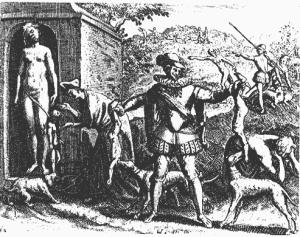
Fonseca wanted dogs on this voyage because he anticipated difficulties ahead. Since the natives had no armor and only light weapons, dogs would be a formidable form of coercion. The twenty dogs that Columbus took with him, and the others that followed, blazed a bloody trial across the New World. Over the years, the explorers brought more and more dogs to the Americas, and virtually all of the conquistadors would employ them as fearsome weapons. Familiar names, like Ponce de León, Balboa, Velasquez, Cortes, De Soto, Toledo, Coronado and Pizarro, all used dogs as instruments of subjugation. A few Greyhounds existed in North America from colonial times. A Greyhound kept the German-born colonial military leader, Baron von Steuben, company through a long winter at Valley Forge. Greyhounds were imported to North America in large numbers from Ireland and England in the mid-1800s not to course or race, but to rid the Midwestern farms of an epidemic of jackrabbits that were ruining their crops. Greyhounds also were used to hunt down coyotes who were killing livestock. They became familiar sights on farms and ranches in Kansas, Missouri, Oklahoma, and Texas. Americans soon discovered that Greyhounds could be a source of sport. In 1886, one of the first national coursing meets was held in Kansas. American coursing was most popular in the western states. 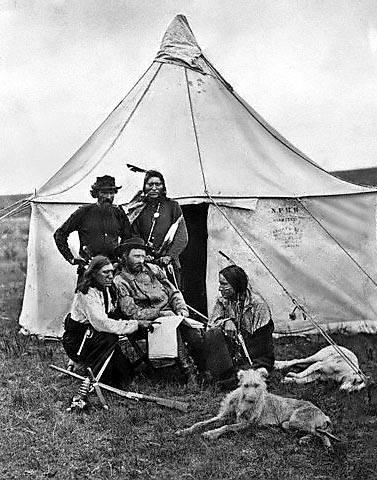
It is thought that the idea of track racing evolved from the desire to hold coursing events within smaller enclosures than the original three miles of course which was used until then. The idea of coursing within enclosures had the obvious benefit that spectators could easily view the proceedings. Fences, complete with holes through which the rabbit could run, were set up within the enclosure and the hounds were released in pairs. The Greyhounds were awarded points for the way in which they pursued the quarry and not necessarily for being the dog that caught the rabbit. In the 19th century, the sport of coursing became one of the most popular of field sports. The Industrial Revolution made many folk of previous working class background as wealthy as their royal counterparts, which in turn allowed them to indulge in the sport once considered the pastime of the rich and ruling classes. Coursing events became popular all over the country - and The Waterloo Cup which was first held in 1837 - is still very popular. With the formation of the National Coursing Club of England in 1858, coursing was turned into more of a business. It began requiring the registration of dogs for its events in 1882. This led to the creation of The Greyhound Stud Book in Great Britain and, later, sister publications in the United States, Ireland, and Australia. In 1912, Owen Patrick Smith invented a mechanical hare which could run in a circular path. He later opened the first Greyhound racing stadium in California. The new sport was very successful and within the next six years he opened 25 more tracks. |

...for Joey's Greyhound Friends. Thank You! 
Please learn here more about Greyhounds, Greyhounds and Children, small animals and Greyhounds and much more... Greyhounds actually come in many colors. Here you can download the Color Chart! |
Copyright © 2009 - Suzanne Reep
Content and/or images not to be produced, copied, or used without the express permission of Suzanne Reep. webdesign & maintenance by cigs.kometweb.com |